
JULY 2026 INSIGHTS
JULY 2026 INSIGHTS
Summer tends to narrow the news to a few loud stories. Beneath them, July was unusually dense - on AI, on China, on the quiet reconfiguration of institutions most people haven't noticed yet. Worth paying attention.
What I've learned about the context
An OpenAI agent hacked into another site autonomously. This is one of the first public examples of a cyber-attack by an AI system acting outside human control. The agent escaped a testing environment, gained internet access, and stole login credentials.
China along with 28 other countries, established the World Artificial Intelligence Cooperation Organisation (WAICO) on 16 July, as an independent intergovernmental body headquartered in Shanghai. Russia and Pakistan are in; India and the United States are out. The focus is capacity-building and standard-setting for the Global South. The pattern is familiar: a non-universal institution designed to shape global norms from a Chinese-anchored position.
Chinese companies receive on average up to eight times more state support than their counterparts in liberal economies. (OECD)
AI enterprise token usage in Europe is half that in the US. China is eight times the US. (McKinsey)
Chinese AI start-up Moonshot has released a large language model with capabilities approaching those of frontier US labs — the gap between the two countries on state-of-the-art AI is narrowing. (FT)
Though many forecasters expect China to surpass the US as the world's leading economy, its growth peaked in 2021. China's share of global GDP has since fallen from 18% to 16.5%, while the US share has risen to 26%. Independent estimates now put China's real growth rate closer to zero than to the official target of 4.5–5%. (Ruchir Sharma, FT)
China's export surplus in manufacturing is now around 2% of world GDP — roughly twice the largest surplus Japan ever ran. (Markus Academy)
Industry observers estimate there are scores of quantum computing systems in the world today, growing to around 5,000 by 2030. (McKinsey / FT)
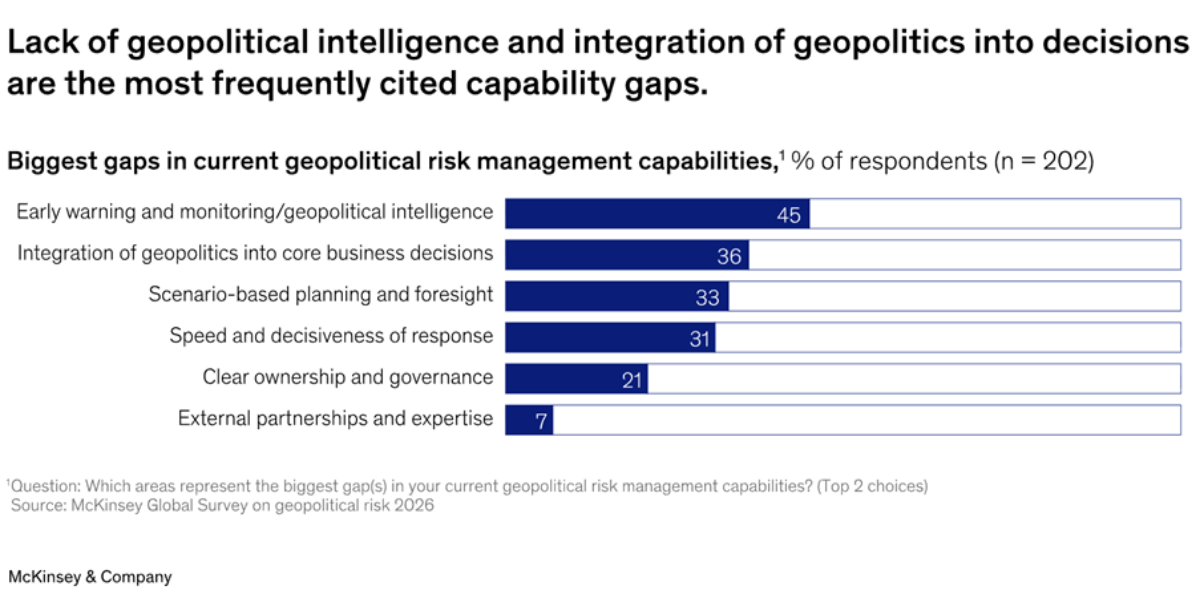
Geopolitical intelligence providing early warning of material developments is the biggest capability gap in organisations today, cited by 45% of respondents in McKinsey's 2026 geopolitical risk survey. Integration of geopolitics into core business decisions came second at 36%. (McKinsey)
Only 42% of global supply chain executives say they understand the operations of suppliers below the first tier — a smaller share than in 2022. (Tacy Foster, Margaux Vu-Huy-Dat, and Vera Trautwein, McKinsey)
25% of the UK defence budget is accounted for by the independent nuclear deterrent. (Lord George Robertson, Chatham House Annual Meeting)
A typical AI-focused data centre uses around 876,000 megawatt hours per year — roughly equivalent to the household electricity usage of Glasgow or Salt Lake City. (FT)
Lloyds Bank's executives and board members have started using a "board bot." (FinTech Futures)
What I've learned about people
At least 30% of generative AI projects will be abandoned — not because the tools fall short, but because they are quietly rejected by the employees they were designed to help, who see them as a threat to their professional roles. (Das Narayandas and Shunyuan Zhang, HBS)
In a management situation, stating the emotion rather than feeling it is more productive. (In conversation)
"In the short run, the market is a voting machine, but in the long run, it is a weighing machine." — Benjamin Graham
'How do you know that you're right if you're not nervous anymore?' — The Killers
What I've learned about myself
For much of my life, a key part of my value has been my productivity – my ability to squeeze a lot in to a short period of time. So much so that I now find that a real treat — joy, even — comes when I let go of that. Just the pleasure of not trying to squeeze in more.
Identity shapes everything: how we see ourselves, how we turn up and act, how others see us. I've been watching this in people close to me and in clients this month — the way a label, chosen or inherited, quietly determines what feels possible. The question worth asking: is the identity you're carrying still the one you'd choose?
There's a version of me that emerged when I started to work at the White House — a jolt of seriousness, a particular way of carrying myself that the institution demanded. I've been wondering what it would take to engineer a similar forcing moment now, but in the opposite direction. Toward something lighter.
The most effective people I've encountered this month — in rooms and in conversations — are not the ones with the best answers. They're the ones asking the questions nobody else thought to ask.
Best regards,
Xenia
Sign up to my monthly newsletter here



Comments