
DECEMBER 2025 INSIGHTS

As 2025 closed, I found myself reflecting on what has shifted—and what has hardened—over the past twelve months. As we enter 2026, like so many others, I’ve been working on my annual State of the World assessment which I’ll have out in the coming weeks. An early teaser – greater volatility, more widely diverging scenarios, and the behaviours leaders will need to navigate them. Meanwhile, here are the signals from December that feel particularly telling.
What I’ve Learned About the Context
• China’s trade surplus exceeded $1 trillion for the first time. Two decades ago, Chinese exports hollowed out factories in the West. Today, the same dynamic is playing out across parts of the Global South, where thousands of jobs are being displaced. The distributional consequences of globalisation are shifting again.
• Demographics as destiny: In South Korea, for the first time, citizens in their 70s now outnumber those in their 20s. This isn’t just a social story—it’s an economic, fiscal, and political one.
• Foreign business confidence in China is deteriorating. A September 2025 survey by the American Chamber of Commerce in Shanghai showed optimism at a historic low, with just 41% of respondents positive about their future outlook.
• Political churn as a signal: The UK has had seven prime ministers since the iPhone was invented—and seven in the 42 years before that. Institutional instability now shows up not as crisis, but as background noise.
• The aim of the Chinese leadership is to build “an economic fortress” (FT),
• Traditional science seeks causation; big data prioritises correlation. (Thanks to @Kenn Cukier for the framing.)
What I’ve Learned About People
• Leadership prioritisation: “If leaders don’t articulate their priorities clearly, people don’t know what their own priorities should be. Time, energy, and capital get wasted.” This is, according to Bob Iger in The Ride of a Lifetime, what separates out great managers from the rest. In volatile contexts, clarity is not a ‘nice to have’; it’s a strategic asset.
• Certainty is the enemy of curiosity.
• We can’t always make things better. But we can always hold space for grief.
• Guerrilla thinking is becoming a core capability. I’m noticing that the people who get things done are rarely those with the most authority, resources, or perfect plans. Instead, they work around constraints rather than confronting them head-on. They move opportunistically, test ideas in small ways, exploit moments of ambiguity, and adapt quickly as conditions shift. This isn’t disorder or rebellion—it’s pragmatism. In environments where rules are fluid and certainty is scarce, linear strategies fail. Progress now comes from flexibility, local advantage, and momentum. (Thank you, @Tatiana Mitrova, for prompting this line of thinking.)
• ‘People sometimes shy away from taking big swings because they assess the odds and build a case against trying something before they even take the first step. One of the things I’ve always instinctively felt is that long shots aren’t usually as long as they seem.’ (Bob Iger, The Ride of a Lifetime).
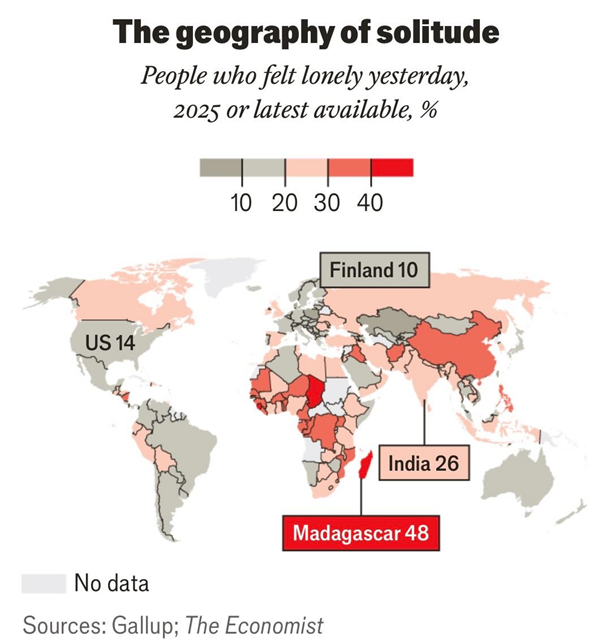
• Loneliness and inequality travel together. Poorer societies also tend to be lonelier—a pattern explored powerfully in a recent Economist piece that’s worth reading. (Economist link)
What I’ve Learned About Myself
• I want to bring more laughter into my work—not as levity for its own sake, but as a way of opening space, perspective, and connection.
• I’ve become disconnected from my body. I override its signals and default to my head. That doesn’t serve me, or the quality of my work. I want to relearn how to listen to it. That feels like both a personal and professional discipline for the year ahead.
As we head into 2026, these questions feel as important as any formal strategy.
Thank you, as always, for reading and for engaging with these ideas over the year. More soon on the broader State of the World assessment.
Best wishes,
Xenia
To read more about my work, visit my website here


header.all-comments